Why South Africa Controls Platinum Supply Right Now
South Africa dominates platinum mining and refining because the metal sits almost entirely in one geological formation there, leaving global supply exposed whenever geopolitical shocks hit demand.
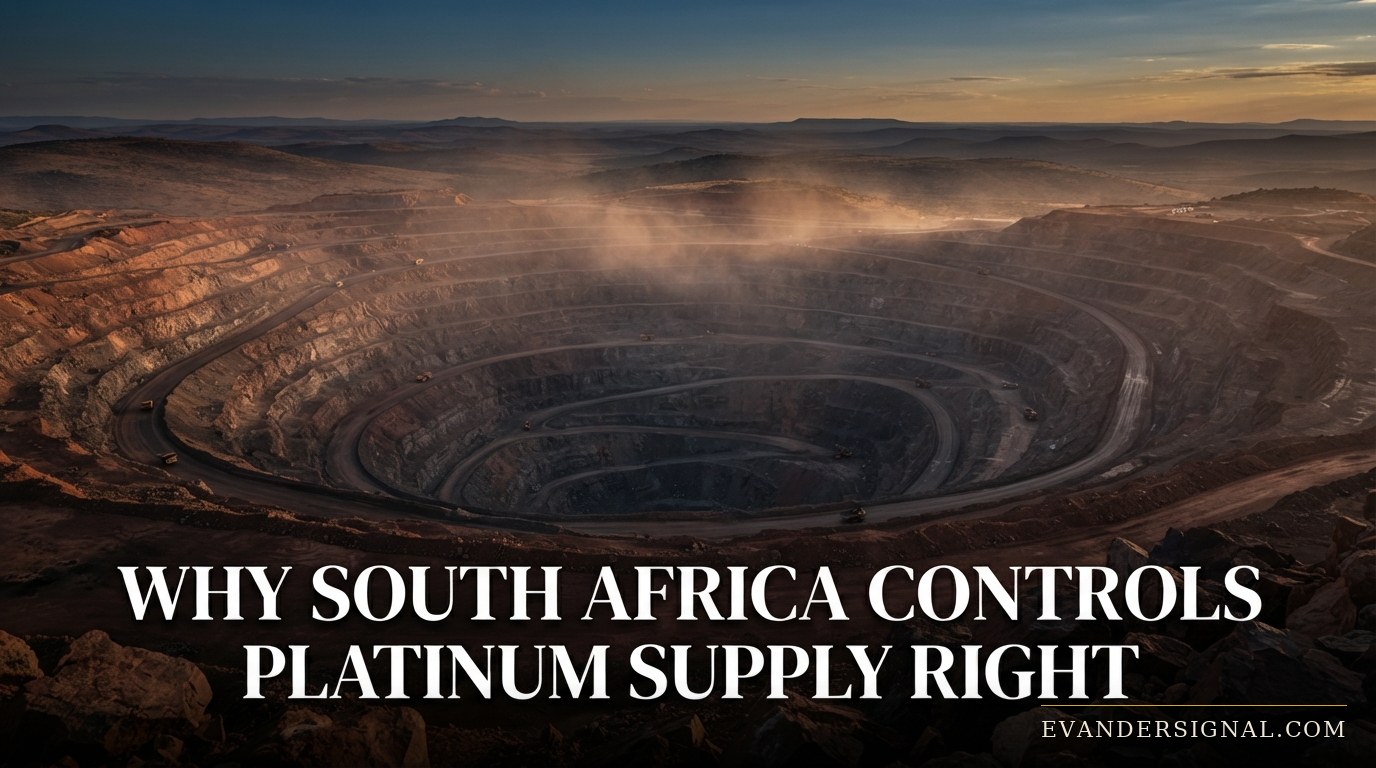
- Platinum trades at $4,097.30, up 23.51% over the year but 23.0% below its 52-week high of $5,318.40.
- The Platinum Risk Index reads 6.36 (neutral-to-bullish), built from 444 stories, dominated by Middle East and Russia geopolitical risk.
- After past one-day down shocks like today's -1.20% move, platinum has historically been higher 53% of the time five days later, median +0.22%.
A Middle East escalation, and a metal with one supplier
Today's platinum headlines are almost all about oil, not mines. US strikes on Iran continued into a 12th night. Houthi forces claimed attacks on two Saudi tankers, opening what Reuters called a new chokepoint risk in the Red Sea. Brent crossed $95 a barrel. None of this happened in South Africa. But it explains why so many traders are asking why South Africa controls platinum supply today — because when the Middle East destabilises, the market is reminded how little geographic diversification platinum actually has.
That concentration is not new. It is geological. The overwhelming majority of the world's mined platinum comes from a single rock formation in South Africa, the Bushveld Complex, worked by a small number of large, deep, capital-intensive mines. Refining is similarly concentrated in a handful of South African smelters. There is no equivalent second producing region that can flex output quickly if South African supply is disrupted — by a strike, a power cut, or a smelter rebuild. That structural fact is why any story that raises the geopolitical risk premium tends to move platinum sentiment even when the news itself is thousands of miles from a mine.
What the measurement says today
The Platinum Risk Index reads 6.36 today, in neutral territory but tilted bullish, built from 444 weighted stories with 68% evidence coverage. The dominant channel feeding that reading is Geopolitical & Russia risk — the Iran war, the Red Sea tanker attacks, refinery strain, and the broader risk-off mood that the Reuters and Al Jazeera wires captured through the day. One story in the mix, on US-Russia diplomacy over Ukraine, points the other way, toward de-escalation. The net reading nonetheless comes out clearly bullish for platinum, reflecting how heavily the geopolitical channel is weighted in today's news flow.
The index itself has no track record yet — it has been running for less than a day — so it cannot be read as a forecast. It is a snapshot of what the news is saying right now, nothing more.
What the price record actually shows
Platinum trades at $4,097.30, down 1.20% on the day, up 2.80% over the past week, down 2.02% over the month, and up 23.51% over the year. It sits 23.0% below its 52-week high of $5,318.40, having ranged between $3,293.20 and $5,318.40 over that period. Realised volatility over the past 30 days runs at 26.9% annualised — a reminder that this is a genuinely volatile market, supply concentration or not.
History offers a modest guide to what follows moves like today's. After one-day declines exceeding 1.77% — today's -1.20% fall does not itself qualify, but sits in that direction — platinum has historically traded higher five trading days later 53% of the time, with a median gain of 0.22%, and higher 56% of the time after twenty days, median +0.63%. After comparably sized up moves, the record shows a similar mild upward tilt: 55% higher after five days, 53% after twenty.
What would change the picture
A verified de-escalation in the Iran conflict, or confirmation that the Red Sea tanker attacks are contained rather than spreading, would likely pull the geopolitical channel down and cool the index's current bullish tilt. Conversely, any disruption originating in South Africa itself — a smelter outage, a labour dispute, a power-supply failure — would combine with today's external risk premium in a way the market has seen before, and would matter more to platinum's fundamentals than any headline from the Gulf.
- ENIsraelis fear Saudi nuclear deal could ignite Mideast arms race - Reuters — reuters_via_gnews
- ENIran war live: US strike kills 2 people; Houthis attack 2 Saudi oil tankers — aljazeera
- ENEasyJet profits plunge 70% as fuel costs soar amid Iran war — guardian_business
- ENTop US and Russian diplomats discuss Ukraine war in Manila — aljazeera
- ENUS oil refineries run at breakneck speeds as wars choke fuel supplies — ft_home
- ENBetween hope and fear: Yemenis react to Houthi blockade on Saudi Arabia — aljazeera
- ENUS attacks Iran for 12th night as the House approves defence spending — aljazeera
- ENHouthis say they attacked Saudi tankers in the Red Sea, threatening new chokepoint in Iran war - Reuters — reuters_via_gnews